A while back I saw a gadget called a TrimmBlock that was used to tune the sails of an RC sailboat. Sadly, when I tried to buy one of these, they were no longer available for purchase. To me there was only one option, make one for myself using my 3D printer.
RC sailboats have lots of adjusters on them to tune the sails for maximum performance in the prevailing wind conditions. There are adjusters that set the camber at the foot of the sails, others that set the sheeted in boom angles, yet others that adjust the twist of the sails. Each of these adjustments has its own value, usually a few millimeters to a few tens of millimeters. The TrimmBlock allowed a skipper to measure and set these values easily and quickly.
When I set out to reproduce the TrimmBlock I quickly adopted a number of improvements and changes to the design. I also included a pivoting plate attached to the measuring part that had the base measurements for multiple sailboats etched into it.
The measurement plate has large notches along one edge and small notches along the other edge. The notches correspond to the millimeter measurement numbers on top. The triangles at one end indicate where the measurements relate to.
The large notches fit the jib booms whereas the small notches fit the backstay and topping lift lines. To set the camber of a sail, large notch corresponding to the required setting is placed on the boom at the 40% chord position and the reference end placed to touch the foot of the sail. The sail camber adjuster is then used to make the sail fit neatly to the reference end of the tuning stick.
The second plate is pivoted with the measuring plate and holds the settings for the cambers, boom angle, and twist of each sail. In the graphic the measurements are listed for both DF65 and DF95 sailboats. The pivoting rivet comes in two parts that are glued together to complete the assembly.
It seems to me that the choice is a simple one; do we want cheap gas and radiation or do we not. We have survived for seventy years with the threat of nuclear Armageddon. But our adversaries were mostly sane and had similar objectives to our own. Now we face an adversary who has Armageddon as their ultimate objective, and they do not seem to be guided by the usual mores of civilized behavior that is to be found in the rest of humanity.
My father served in WWII, spending almost five years as a POW mostly in Poland. He well remembers Neville Chamberlain getting off and airliner while waving a piece of paper and declaring, ‘Peace in our time.’ That then was the poster board image of appeasement that my father and his fellow soldiers were obliged to pay for.
For almost fifty years a stream of American Presidents and diplomats have similarly alighted from airliners while declaring their version of ‘Peace in our time.’ Meanwhile Iran has used its oil income not to emancipate its people but to fund and encourage terrorist groups around the middle east and the rest of the world. Now they are close to having atomic bombs with no unwillingness to use them while we bitch about the price of gas.
The price of gas has certainly increased during the current conflict, although for most not as much as it was for Californians beforehand. The major reason that oil tankers are not transiting the Straights of Hormuz is that the owners cannot obtain voyage insurance from Lloyds of London or any other marine insurer. Once the tankers can be indemnified for their voyage the cost of gas will come down. The question for Americans to answer for themselves is what cost they are willing to endure for cheap gas. Are they willing to allow Iranian terrorists to have nuclear weapons that they may mount on their rockets to threaten their neighbors and all of Europe with. Perhaps Iranian sponsored terrorists will sail a nuke up the Mississippi in a barge to park it in St. Louis and issue blackmail demands before detonating it anyway.
It seems to me that the choice is stark, but since I’m much nearer the end of my life than to the beginning of it, I’ll let others decide how they want to live in their future since that future is likely to be much longer than mine.
3D printing is a very capable method of producing custom parts for model RC boats. I use Autodesk Fusion 360 to design my parts and 3D print them using my Creality Ender Pro. I typically use Tough PLA filament for my parts. It’s easy to print and is generally tough enough for the type of sailing I do. If you want to use a more exotic filament material that your printer doesn’t handle very well, you can get your parts printed in a choice of materials by any number of vendors on the Internet.
Here are some pictures of the type of parts I have made for my boats.
Victoria Parts
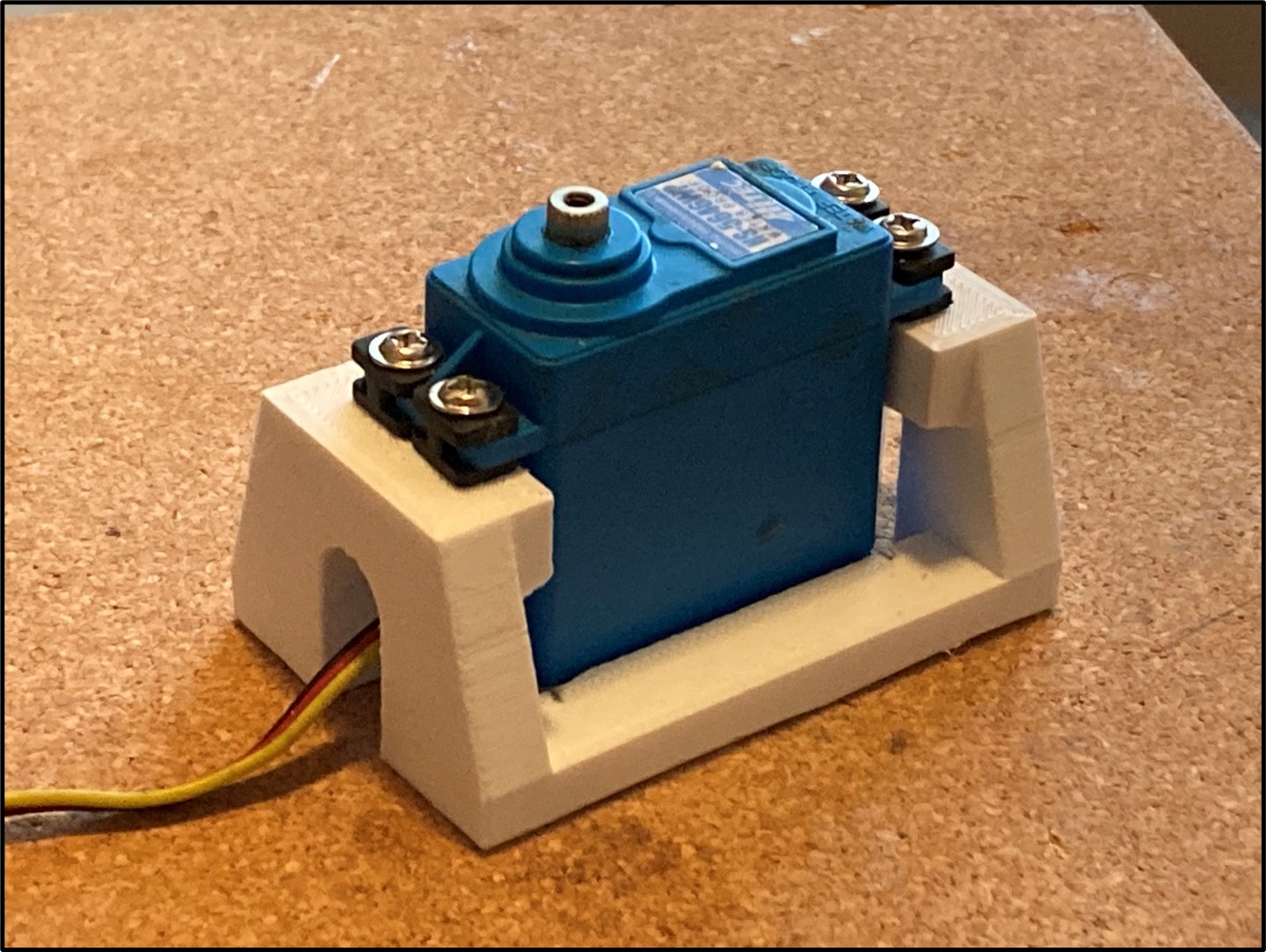
This graphic shows a Victoria servo mount with various sail servo and rudder servo combinations, a deck brace, rudder arms, and boom fittings, all of which have been 3D printed.
Victoria Gooseneck — (9mm carbon mast)
This graphic shows a gooseneck for a 9mm carbon mast for a Victoria. The gooseneck is drilled for a 4mm diameter swivel bolt, and for channels for hold down line for the main boom.
DF65 DF 95 Tuning Stick
This graphic shows a 3D printed tuning stick for DF65s and DF95 sailboats. The stick is made of two parts, one with the measurement notches, the other with the standard values for DF65 A+ rigs and DF95 A rigs. The two parts are fastened together with a plastic rivet that allows them to swivel. Other values can be written on the backs of the parts using a Sharpie.
I got myself a 3D printer for a Christmas gilt. Well actually, my wife bought it as a gilt but I specified the type and where to buy it from. Before you get all hissy, she specifies her jewelry gifts for me to buy for her so it is a two-way street. The printer I got is an Ender 3 Pro for the 3D printing cognoscenti. For everybody else, it’s possibly the most popular 3D printer at the moment because of its price and capability. I’m pleased with it and I have been busy making things to try it out.
Dual Extruder 3D Printer
“So what is a 3D printer and why did I want one?” I hear some of you say, well it’s a device that produces 3D objects from a computer modeling program. For most hobby-grade 3D printers it does this by melting plastic string to make the object. The plastic string comes as a reel that is mounted to the printing machine. The string, or filament as it’s properly called, is fed into heated nozzle where it is transformed into a molten thread. This thread is then placed onto the surface of a platform or platen that is moved from front to back by the computer. The nozzle is mounted so that it can be moved from side to side and up or down, also under computer control. By drawing a two-dimensional slice of the object being built onto the platen, then lifting the nozzle up a little bit before drawing the next slice on top of the first, the 3D object can be made, slice by slice.
These printers are used by hobbyists for fun projects. I wanted one to make parts for my model planes and model boats. Simple parts that cost a lot to buy and are hard to find. 3D printers are also used professionally to produce prototypes of new products for consumer testing or complex parts for high technology industries. More complex 3D printers are used to produce prosthetic limbs and other complex structures.
3D-printed Brake Caliper
3D-printed Prosthetic Limb
Specialized printers produce sintered metal objects such as jet engine compressor blades. SpaceX makes parts for their rocket motors using a metal deposition 3D printer. Other printers use a bath of metal powder and a laser to produce the 3D print. Yet others use a bath of liquid monomer chemical and a laser that draws on the surface generating a polymer trace to make the 3D object. The applications continue to grow as more and better 3D printers are developed.
The mention of laser 3D printers reminds me of a time long ago and far, far away when I was working as a postdoc researcher in the chemistry department of a large university in England. We were studying the chemical applications of laser technology. We did in fact produce the first laser induced chemical reaction
3D-printer Compressor Blades
and the first laser induced reversible isomerization. In our department at that time we had a guest member of staff who was given facilities for his research but was not paid a salary. He earned his living by scientific writing, particularly in writing a weekly column for the UK’s most prestigious popular scientific magazine.
Laser-powered 3D Printer
We would often meet over coffee where he would present us with his latest crazy idea for a column. These columns were very amusing and intellectually challenging since they would always have within them a technical flaw that made their claims specious. On one occasion he asked about the possibility of filling an aquarium tank with a monomer that required two different laser colors simultaneously to produce polymer. If we could organize things such that the two different lasers were made to cross inside the tank, they would produce a blob of hardened plastic polymer. By scanning the lasers about we could make a three dimensional object; an early generation 3D printer before they had been invented; we thought. This ‘invention’ was only for the amusement of his readers but when he published the idea little did he anticipate the reaction. He and his publisher were served with a writ to cease and desist by a company claiming contravention of their patent. This writ came from some company in the USA who didn’t seem to have much of a sense of humor and were unable to detect the spoof that it was.
SpaceX Draco Rocket Motor with 3D Printed Parts
My current interest in 3D printing is focused on my RC sailboat hobby; I want to make a 3D printed model sailboat. I know that others have done this but I’m not interested in copying them so much as learning from their experience to build my own model. Since my printer doesn’t have a print volume large enough to accommodate a complete model, I will have to build it in sections then glue them together, much like most large ships are made today.
To do the design work I use Autodesk Fusion 360 as my CAD program. This is available for free for non-commercial hobbyist use. When I have an object that I want to print I save it as a STL file then I use Ultimaker Cura to slice it. The Cura slicing program does basically what it says; it makes the 2D slices from the 3D model that are then stacked on the printer to produce the 3D object. Once I have the GCODE file made by the slicer, I load it into the printer, load up the printer with the chosen filament, warm it up and set it going. Prints can take a long time. An object about 1cm by 1cm by 1cm will take a bit less than an hour to print but larger objects can take all day.
Luckily I have two sailing buddies who have printers and they have given me lots of tips on how to get the best results. They also made some parts that I wanted before I got my own printer. The most notable of these parts was the mold for a ballast bulb that one of my friends made for me for my US 1M build.
Ballast Bulb Design for my RC Sailboat
He took the airfoil shape that we wanted and modeled it using Fusion 360. The CAD software gave an estimate of the volume of the torpedo shape and we combined that with our best estimate of the density of the material we would use until we got close to the 4lbs weight I was looking for. He then printed out the half mold in two sections on his printer. I glued the two parts together to get a mold of the lower (or upper) half of the bulb shape. This I filled with epoxy resin and #7 lead shot. When it set, I removed the shape, made a second piece and epoxied the two together. A little filling and filing, a couple of coats of primer, a coat of black paint and some clear lacquer, and I had a perfect bulb weight for the keel of the boat.
As I said earlier, I’m having fun with my printer. If you want to know more just Google 3D printing and you will get a huge list of information about them including places that will make a 3D print for you as a service, albeit not a cheap one.
When I was a kid living in Scotland, I remember my dad getting us out of bed in the middle of the night to show us a comet in the sky out of our bedroom window. This occurred in the 1950s. The comet was easily visible with the naked eye and had a very distinctive tail. I don’t know for sure which comet it was but a little research suggests it was either Arend-Roland or Mrkos. My money is on Mrkos.
Comets Arend-Roland (left) and Mrkos (right)
Both these comets were visible from Earth months apart in 1957 and both were non-periodic comets; so they won’t be back. I have never seen another comet so clearly since then.
There’s a lot of fuss today about comets and asteroids and their possibility of impacting our planet. It turns out that we are struck by at least 6000 asteroids per year, most of which are small and burn up in the atmosphere. It’s estimated that about 100 tons of dust/sand-sized debris impact our atmosphere every day.
Armageddon?
It seems that asteroid impacts are quite common so I think the fuss is really about those that are large enough to cause a threat to life and property. Asteroid impacts of this size are rare. Impacts that are large enough to cause damage and some loss of life happen about every 2000 years on average with those large enough to threaten our civilization occurring every few million years.
Most asteroids orbit the sun in a belt, the Asteroid Belt, between Mars and Jupiter. This belt lies in the plane of the ecliptic, the disk around the sun within which all the planets orbit. Now and again one of these asteroids is disturbed in its orbit, usually by a collision with another asteroid, and fall inward toward the sun in the plane of the ecliptic.
Asteroid Belt
As it falls toward the sun it gains speed, swapping its potential energy for kinetic energy. When it gets close to the Earth it can be moving at up to 150,000 miles per hour. The law of gravity means that the speed of the falling asteroid does not depend on its mass, but its kinetic energy does. A large mile wide asteroid weighing millions of tons and traveling at 150,000 miles an hour will be an extinction-level event if it hits our planet; the planet will recover, we will not.
Comets are thought to come from either the Kuiper Belt, a disk-shaped cloud of objects and lies beyond the orbit of Neptune, or the Oort Cloud that is thought to be a spherical cloud far beyond Pluto that contains up to a trillion comet-like objects. Unlike asteroids, comets typically travel toward the sun on a path that is not in the plane of the ecliptic.
Kuiper Belt and Oort Cloud
These more random trajectories and the relative infrequency of comets compared to asteroids makes them less of a threat. Although it might have been a comet that caused the impact 65 million years ago that is attributed to the extinction of the dinosaurs, it was more likely to have been an asteroid, if for no other reason than the abundance of Iridium that it seems to have left behind.
I do hear people worrying about the destruction of the planet; they should not fret about the Earth being destroyed. Our planet has survived many extinction events and come through it, changed to be sure, but still a vibrant home to new life forms to thrive. The human species may be exterminated by a comet or asteroid impact, but the planet will continue to spin on its axis and orbit the sun as before, it will just do so less a number of the species currently living upon it. When folks claim to be trying to ‘save the planet’ they aren’t, they are trying to save themselves in the manner that they find comfortable. I don’t hear them consulting cockroaches and ants for their opinion on planet-saving.
Our planet is about 4.5 billion years old. During that time it has gone through many changes. The late heavy bombardment is thought to have happened about 4 billion years ago and is thought to have been a time when Earth was hammered by a deluge of asteroids leaving the surface molten lava. Life would not have been possible during this time. As the Earth cooled the early atmosphere consisted mostly of nitrogen and carbon dioxide, 200 times what is in the atmosphere today, with an abundance of methane, ammonia, water vapor, hydrogen sulfide, and neon, but no oxygen. The oxygen-rich atmosphere occurred about 3 billion years ago and was caused by the emissions of oxygen by cyanobacteria, using photosynthesis, that thrived in the CO2 rich atmosphere. This was chemical warfare on the global scale as the planet was changed forever. The arrival of free oxygen kick-started the evolution of life on Earth. But it would not last as life on Earth endured a sequence of mass-extinctions beginning with the Ordovician-Silurian Extinction some 440 million years ago.
Life has thrived then been extinguished at least five times in the history of our planet. It seems that more than 99% of all species that ever lived on Earth are now extinct. The first mass extinction, the Ordovician-Silurian Extinction, occurred about 440 million years ago and killed off about 85% of all species, mostly small marine organisms. It is thought that the cause was the rapid swing of the global temperature from very much colder to a very much warmer bounce, with changes in sea levels and atmospheric CO2 concentration. It doesn’t seem that comet or asteroid impacts were responsible.
Life thrived again on Earth until the next mass extinction killed 75% of all species, falling hardest of marine organisms including corals and trilobites. This Late Devonian Extinction happened over a 20 million year span starting about 380 million years ago. It is thought that this extinction was caused by mass volcanism, probably in what is now Siberia, that resulted in lower oxygen levels in the atmosphere.
Volcano
The Permian-Triassic Extinction, 252 million years ago, is also called the Great Dying. It killed off 96% of all marine species and 75% of all land species. The world’s forests were wiped out as well as large numbers of insect species. The largest contributor to this global calamity was the Siberian Traps, a complex of super volcanos that spewed 14.5 trillion tons of carbon into the atmosphere. The global temperature rose about 30F with the result that the oceans lost up to three-quarters of their oxygen.
Life on Earth got busy recovering from the Great Dying but only 50 million years later, about 201 million years ago, some 80% of all species were wiped out in the Triassic-Jurassic Extinction. The causes of this extinction event are the subject of much debate. Some contend that the cause was global warming caused by the release of CO2 into the atmosphere by volcanism associated with the break up of the super-continent Pangea. Others blame the release of methane into the atmosphere while a third group of scientists blames a combination of volcanism and the impact of a large comet or asteroid. What is not debated is that this extinction event cleared the way for the dinosaurs to rule the Earth.
Dinosaur
The dinosaurs prospered for 150 million years until they were wiped out along with 76% of all species by the Cretaceous-Tertiary Extinction 65 million years ago. The causes of this extinction have been long debated but the majority view nowadays is that it was caused by a large asteroid impact off the coast of the Yucatan Peninsula. The jury is still out on the verdict on the cause with a vocal minority blaming global warming caused by volcanism and other tectonic effects. What is not in doubt is that land dinosaurs were profligate before this event and non-existent afterward, leaving the planet free for the rise of the Mammals, including us.
What can we conclude from this history of the evolution of life on our planet and the mass extinctions that eliminated most of the life at five times in our history? I think that the first obvious conclusion is that our planet is very robust and can shake off these calamitous events as can be seen by the average global temperature over the last 500 million years.
Global Temperature Last 500 Million Years
Life too seems to be very robust in the abstract if not the specific.After each annihilation of species, new life evolves and thrives on our planet. It seems therefore that while the life of humanity may be fragile and in danger of extinction from one calamity or another, life on planet Earth is not subject to the same danger. When we are gone, our planet will keep spinning and orbiting the sun and new life will keep evolving until our sun goes red giant and consumes it. I will not be here to see that event but I wish I could.
The last place I lived in the UK before coming to the US was a small village in the west of England. The village was distinguished by its great country pub, its history that went all the way back two thousand years to Roman times, and by its close proximity to a nuclear power station. Our cottage sat on the outskirts of the village with a clear view of the power station about two miles across farmer’s fields. On cool, calm nights I could hear the power station’s PA announcements in the faint distance.
I never considered it to be dangerous to live there although many others at that time were demonstrating against nuclear power with the expectation that these stations would explode like an atomic bomb. There was a heated political debate going on in the UK at that time about continuing with nuclear power. In the pub one night I asked one of my neighbors about his opinion on this topic. He was set against nuclear because of its perceived dangers. I pointed out that although I considered the dangers to be low they were at least democratically shared amongst all the consumers of the power generated. I continued by comparing this to the use of coal power which in the UK at that time in an average year killed about 50 miners and retired about 3000 with health issues, mainly lung disease. My neighbor replied that since he wasn’t likely to become a coal miner he much preferred coal power to nuclear where he did share a risk. As someone who comes from a coal mining ancestry I was not best pleased with his opinion, but I let it pass.
My only regular contact with the power station was the weekly servicing of a radiation monitor that was mounted on a power pole beside the road just over our garden hedge. Since I was working most days I didn’t see this happen very often. One day that I was at home they turned up as I was mowing the front yard. A small white van pulled up. The driver got out and removed an extendable ladder from a rack on the van roof. He placed the ladder up against the power pole and extended it up toward a small box attached to the pole. A young lady then emerged from the van. She was dressed in a white boiler suit and wore a white hardhat. Carrying a clipboard she climbed the ladder and unlocked the box. She then removed the radiation monitor and looked at it – then she screamed. The scene was like a cartoon. She seemed to descend the ladder without touching the steps and while turning around in midair with feet pounding. The clipboard and hardhat went one way as she ran up the road in the other direction, still screaming. My life passed in front of my eyes – were we all going to die of radiation poisoning?
As it turned out we were not in any danger. The lady returned when she calmed down, picked up her hardhat and clipboard, and climbed back up the ladder where she again read the display on the monitor. When she came back down she noticed me leaning on the handles of my lawnmower and staring at her in astonishment. She explained that she was terrified of spiders – arachnophobia – and had encountered a really large and hairy member of the species when she opened the box, thus explaining the histrionics. At this point she got back into the van, the driver collected the ladders and placed them back on the roof rack and the drove away. I believe my heart was still racing an hour or so later but I put it down to the yard work.
As I mentioned above, there was a vigorous debate about nuclear power going on in the UK at this time. The UK had experienced one of the worst nuclear accidents in 1957 at Windscale, Cumbria, when one of the reactors designed to produce plutonium and tritium caught fire and spewed radioactive contaminants into the atmosphere. This reactor design consisted of a large pile of graphite bricks with horizontal holes drilled through the pile. Fuel cartridges were pushed through the holes to become irradiated before falling out the far end into a water pond to cool. This whole arrangement was cooled by atmospheric air that got sucked in at one end and sucked out the other end by natural convection by being directed up a chimney and vented to the atmosphere.
Windscale Reactor Pile
If you imagine that this arrangement sounds dangerous, it is, but the government wanted the plutonium and tritium for the UK nuclear weapons program. When the fire occurred and vented the radioactive contents of the fuel bundles into the atmosphere, the UK government hushed it up lest public opinion endanger their nuclear weapon ambitions.
Since the inception of the idea of using nuclear reactors to generate electricity a number of reactor designs have been produced and distributed throughout the world. The Windscale experience led the UK to develop the Magnox Gas-Cooled Reactor design for use throughout Britain. This reactor is a graphite-moderated CO2 gas-cooled design.
Magnox Reactor
This design is not only a reasonable one for producing electricity, it’s also a weapons-grade plutonium generator. The one next to my house was one of these reactors and holds the record as the longest serving nuclear reactor in the UK.
In the midst of the nuclear debate in the UK, our local power station decided to open its doors to the public to let them see the internal operation of the power station. It was to be open on a Saturday and Sunday to conduct guided parties of the public around the power station. I had to go see. There were hundreds of people there awaiting their tours but it was all well organized and I was quickly part of a group led by a power station worker in the dress uniform of white boiler suit and white hardhat.
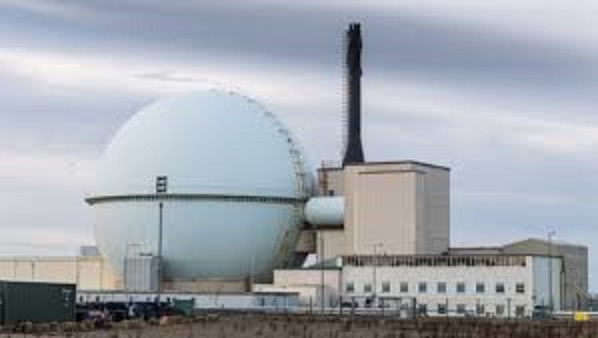
The Reactor Next To My House
There were two reactors in the power station, both constructed of prestressed, reinforced concrete. At the bottom of each reactor, there were a number of huge electric motors that drove the fans that circulated the carbon-dioxide gas to cool the core. As we followed our guide around the cylindrical concrete construction of the reactor we could feel the warmth from the walls, It was quite toasty in the reactor hall. We finally emerged out of a door into a large hallway that stretched for some distance. In one corner there was a large grey-green metal machine that looked like some kind of alien robot. A lady in our party approached our guide, pointed at the machine, and asked, ‘Is that the reactor?’ Our guide answered, ‘No, that’s the refueling machine.’ ‘Well, where is the reactor’ she asked. ‘You’re standing on it’ the guide replied. I think she must have jumped about a foot in the air before scuttling off through the door and down the stairs to safety. It was hilarious. I did wonder what she thought she had been looking at as we climbed the stairs around the concrete edifice. Despite this lady’s reaction, the weekend was a resounding success with thousands of visitors over the two days.
The nuclear reactors in use today for the generation of electrical power were designed during the era of the Cold War. These designs were substantially motivated by military objectives; either to produce fissile materials or to power warships. Efficient power generation was of course the main aim, but the military requirements did compromise their design. Perhaps the most hazardous design was that used in the Soviet Union, including the one in Chernobyl. It uses boiling water and a graphite moderator.
Chernobyl Reactor Design
When the coolant level fell, the hot graphite was exposed and reacted with steam to produce a large bubble of hydrogen. When the hydrogen ignited it blew the top off the reactor as well as blowing out the bottom. The result was that the reactor core melted into a kind of lava and flowed out of the containment and into the basement. All of this was caused by a rushed safety test that was conducted by operators and managers who were being forced to meet an artificial schedule or suffer the wrath of the Party bosses.
In the case of the Fukushima meltdown, it was not a reactor design flaw that caused the accident, it was the installation of the auxiliary support systems that failed to take into account the extraordinary circumstances that befell the reactors. The Fukushima reactors were a boiling water design that during a shutdown required that the primary coolant be circulated through the core until its temperature fell to safe levels. The reactors had steam-driven pumps to circulate the coolant with electrically powered backups used as the core cooled and the steam pressure fell.
Fukushima Reactor
The electrically driven pumps could use the power being generated by one of the other reactors, assuming it too was not in shutdown. In addition, they could use power from a dedicated conventional power station located some distance away. As a final backup, they had an array of diesel generators located in the basement plus a host of batteries on the roof. On the fateful day of the earthquake, the tremor instigated an emergency shutdown of all of the reactors that were in operation at that time. It also disconnected the conventional power station from the grid. The diesel generators were enough to keep the coolant flowing for days until the tsunami topped the seawall and drowned them. Only the batteries were left and they ran down after a few hours. Eventually, the loss of coolant caused the core to be exposed and a hydrogen gas bubble exploded, destroying the containment and exposing the melting core to the environment.
In my opinion, this disaster was caused by a lack of imagination when they designed the backup generator installation. Had the generators been distributed around the site, high and low, and had the seawall been built to a height higher than twice the highest imaginable tsunami, and had the conventional power station been hardwired to the reactors, perhaps the disaster would not have happened. As it was pressure to do enough at an acceptable cost, and within a manageable timescale, resulted in a system that was vulnerable rather than robust, with all that it has entailed.
Until nuclear fusion becomes available to deliver unlimited energy with no radioactive hazard, fission reactors will be the cleanest and most reliable source of the power we need. However, I suggest that the new breed of nuclear reactors that are based on safety science rather than military necessity are the way forward.
Many people are curious about the universe they live in. Many of them are afraid to ask obvious questions in case they are accused of asking stupid questions. When it comes to matters of science there are no stupid questions; it’s the simple questions that reveal the most interesting findings. Here I want to pose some of the most obvious questions that people might ask. These questions, it turns out, are not simple but reveal some of the deepest and most complex properties of our universe. Here I am reviewing some of the questions that people ask together with my understanding of how science answers them. Remember that I could be wrong in my explanations but I think I’m mostly right.
One of the first questions people ask is ‘how old is the universe?’ This is a very non-stupid question. Scientists and philosophers have been staring at the night sky for centuries and more, contemplating this very question. Now we have an answer that has been a long time coming. As best we can tell our universe is about 13.8 billion years old.
Your next question should be, ‘how do you know that?’ That too is not a stupid question. Our first clue came from the work of the famous American astronomer, Edwin Hubble and the Belgian astronomer Georges Lemaitre. Hubble found that distant galaxies were moving away from each other at a speed that increased with distance, Hubble’s Law. That being the case, turning the clock backward would find all of the galaxies in one place at one time. This finding was initially greatly resisted by other astronomers who insisted that the universe was static and infinite in time and space. It was one of them, Fred Hoyle, who coined the phrase Big Bang as a derogatory epithet. The phrase stuck as did the expansion theory with its conclusion of a finite age to the universe.
Modern estimates of the age of the universe depend less on Hubble’s Law and more on the precise measurement of the Cosmic Background Radiation (CMB).
Cosmic Microwave Background
As the universe expanded after the Big Bang, the universe cooled from the almost unimaginable temperatures that it started with. That cooling continues to this day. By measuring the temperature of the CMB today we can estimate for how long the initial fireball has been cooling, leading to the most accurate estimate of the age of the universe of 13.8 billion years.
The next question people might ask is, ‘how big is the universe?’ That too is not a stupid question and it has multiple answers. We can see up to 13.8 billion years away, almost back to the beginning of the universe, but it has expanded since then. Because of this expansion, what was 13.8 billion light-years away is now estimated to be 46 billion light-years away. Thus the diameter of the observable universe is estimated to be 93 billion light-years and still expanding.
There is no sure answer to the question, ‘what existed before the Big Bang?’ There have been many attempts to answer this question with no completely convincing theory. These attempts continue today with some claims that the CMB shows signs of ‘bruising’ caused by contact with an adjacent universe together with other indications of a life before the Big Bang. Steven Hawking and James Hartle suggested in a famous scientific paper that the evolution of the universe was shaped like a shuttlecock, with no beginning. They claimed that asking what came before the Big Bang was like asking what was south of the South Pole.
Shuttlecock Universe
This answer is very unsatisfactory since it avoids an answer. This drives scientists to strive even harder to find a theory that explains the facts and is satisfying.
Perhaps the next question people ask is, ‘what will happen to the universe over time?’ Again there is no clear answer, it all depends on the nature of space and time. We once thought that the future of the universe depended on how much matter (stuff) was in it. It’s a bit like throwing a baseball straight up into the air. Since you can’t throw it fast enough it will fall back down to you. The faster you throw it the higher it will go before slowing down, coming to a stop, and falling back down for you to catch. Imagine if you could throw it really fast, fast enough that it would never slow down enough to come to a stop; it would be gone forever. There are three conditions in this baseball throwing challenge; not fast enough; just fast enough; and more than fast enough. In the first condition, the ball falls back to the thrower. In the second the ball slows to a stop at infinity and stays there. In the third condition, the ball is still moving away when it gets infinitely distant from the thrower. Using Newton’s gravity, these conditions were labeled, elliptic, parabolic, and hyperbolic.
Getting back to the universe. Depending on how much stuff is in the universe, we once thought it could fly apart forever, stop moving at infinite distance, or fall back together into a big crunch. By estimating how much mass we could see in the universe it looked like it would fly apart forever.
Solar System
Then we discovered Dark Matter, and later Dark Energy. When we look at the planets in our solar system as they orbit the sun we notice that those farther away take longer to complete an orbit.
The closer planets complete their orbits more quickly. When astronomers looked at stars orbiting the centers of spiral galaxies they got a shock; the outer stars were all orbiting at more or less the same speed. This behavior, and that of orbiting galaxies in galactic clusters, did not obey the rules of gravity as we knew them.
Spiral Galaxy
One way to make this orbital behavior fit was to propose that these galaxies contained much more matter than we could see; Dark Matter.
To confirm the Dark Matter theory, astronomers started to look for other signs of its existence. One major confirmation was when they saw that individual galaxies could act as a gravitational lens to distort the view of galaxies farther away. When astronomers computed how much gravity was needed to do this it was much more than was visible in the galaxy that formed the lens.
Gravitational Lensing
In addition, when astronomers plotted the positions of galactic clusters in a three-dimensional map of the universe, they discovered that they were distributed in strings and sheets with voids between them much like Swiss cheese or a sponge. It seems that it was Dark Matter that formed the structure of the universe around which ordinary matter such as stars and galaxies coalesced.
Astronomers then calculated how much Dark Matter was in the universe and got another shock. It seems that Dark Matter accounts for about 85% of the matter in the universe while ordinary matter like stars and galaxies, accounts for the other 15%.
Cosmic Dark Matter Web
However, even adding the Dark Matter estimate did not provide enough stuff to slow down the expansion enough to stop the universe from expanding forever. Another shock came when astronomers checked on the expansion rate of the universe using more powerful and more accurate techniques than before; the expansion was accelerating.
According to the usual theory of gravity, Einstein’s General Relativity, the expansion rate must slow down over time due to the pull of the totality of matter in the universe; but it wasn’t. It seemed that another force was at work, much like gravity but this time a repulsive force rather than an attractive one. This force was named Dark Energy, mainly because no one knows what it is or how it works. Most people have heard of Einstein’s most famous equation, E-mc2, and understand that it means that mass can turn into energy and vice versa, but it also means that energy can act just like mass to cause a gravitational pull. In the case of Dark Energy, it seems to cause a change in the overall force of gravity in the universe over time to accelerate the expansion. When astronomers added up the total energy in the universe from Dark Energy, Dark Matter, and ordinary matter, they found that Dark Energy contributed an estimated 69% of it, with Dark Matter contributing 26% and ordinary matter only 5%. It seems then that 95% of our universe is made up of stuff we can neither see nor understand as yet. It also seems that the Dark Energy contribution sends our universe on a one-way journey, expanding forever until all the stars go out and it becomes a cold and dark, and lonely place. We shall be long gone by then.
Before COVID there was polio, sometimes called infantile paralysis. First identified in the late 18th century it was not isolated as a virus until the early 20th century. Epidemics of polio were identified occurring in Europe in the late 19th century in the US in the early 20th century where it became one of the most serious childhood diseases. In those days up to 5% of children and up to 30% of adults died after contracting polio with many more left paralyzed to a greater or lesser extent, usually in their legs. Many spent weeks, months, or years, in an iron-lung as part of their recovery. Perhaps the most identifiable polio sufferer for Americans is Franklin Delano Roosevelt who it’s thought contracted the disease as a young man and was left mostly paralyzed in his legs by it.
Before the advent of vaccines for common childhood diseases and their widespread use, being a child involved running a gauntlet of hazards such as typhoid, measles, whooping cough, mumps, diphtheria, tetanus, chickenpox, and polio. In the early part of the 20th century, large families were common. While these large families were probably a consequence of a lack of contraception, it is also likely that they were also a response to the higher rate of childhood mortality than we see today. Death in childhood was not an unusual occurrence and polio was a major contributor.
The first successful and widely used polio vaccine was developed by Jonas Salk and others in the mid-1950s. This vaccine used an inactivated virus that was grown in kidney tissue taken from Rhesus Macaques (monkeys). It was delivered by injection. A later vaccine was developed by Albert Sabin and others used an attenuated live virus and was delivered on the more familiar sugar cube. It is this later formulation that is widely used today.
Oral Vaccine as Used Today
This then brings me to the story of my uncle and his involvement with the polio vaccine.
My uncle Tommy lived in the south of England in the county of Kent. In the 1960s one of the jobs he had was working for the pharmaceutical company Pfizer where he drove a truck. This is the same company now in the news for its production of the COVID vaccine. Back then they were a producer of polio vaccine. My uncle had the job of driving his truck up to London Airport, now called Heathrow, every week to pick up the monkeys that were used to make the virus vaccine. Since the monkeys were flown in on a transport aircraft that arrived at night, these journeys were nocturnal. He drove to the airport in the evening, arriving after dark, waited around for the plane to land, and then loaded up with the monkeys in cages before heading back to the factory, arriving in the early morning.
Rhesus Macaque
On one of these trips, as he was headed home he was pulled over by the police. For some reason, they wanted to know what was in the truck. “A wagon load of monkeys” he replied. The police were not impressed with this reply and demanded that he open up the truck for their inspection. Now it turns out that the truck he was driving had a side door that could be used to check the health of the cargo. It also had a rear roll-up door that was used for loading and unloading. Since he was by now a bit miffed, he led the boys in blue around the back of the truck to the rear door. It was pitch black as he threw up the roll-up door so one of the constables shone his flashlight into the cargo bay to see what was there. He illuminated a large rhesus monkey that was seriously irritated at having been removed from his home, stuffed into a cage, transported in a cold and noisy airplane, locked into the back of a smelly truck, and now woken up by a dazzling flashlight in his face. His annoyance overflowed, so he pissed right in the face of the cop.
You may imagine that the policeman’s displeasure became magnified as he discovered that the urine of large male rhesus macaques is particularly noxious. He and his partner left in a rush, got back in their police car, and roared off, leaving my uncle with a barroom story that would entertain his audience for decades to come.
In 1961 there was a serious outbreak of polio in the city of Hull in England. Like with COVID today there was not much that could be done other than to immunize the whole population as soon as possible. They eventually immunized over 300,000 people to suppress the epidemic. However, at the beginning of this campaign, they did not have nearly enough vaccine available; my uncle Tommy came to the rescue. His truck was filled with vaccine doses and he headed off to Hull to deliver these urgent supplies. His journey encountered no holdups so he arrived at the outskirts earlier than anticipated. He was so prompt that he arrived at the town hall before the mayor, his entourage, or the media were ready for him. He was immediately turned round to head back to the outskirts where a police escort accompanied his truck to be greeted by the assembled dignitaries and the TV cameras. Delivery of the vaccinations to those in need was not much delayed but I am reminded today in the COVID era that symbolism aways triumphs substance in politics.
It turns out that all vaccines have their side effects. The polio vaccine is no different. In its early days, the inactive vaccine created from monkeys caused a number of serious infections in the US. These infections were traced to faults in the inactivation process leaving the vaccine contaminated with live virus. After this production problem was corrected the vaccine has been shown to be widely effective with an infection rate of slightly more than one case in one million inoculations. The early, monkey-based vaccine used from 1950 to 1960 is thought to have contained a monkey virus that may have increased the cancer risk for the 100 million US citizens who were vaccinated at that time.
As I listen to the news I hear chatter asking why the Pfizer vaccine has to be kept so inconveniently cold, and why isn’t there enough vaccine to inoculate everybody who wants it now, and who should get it first. I’m struck by the lack of thanks that the entitled have within themselves. In their ignorance, they have no idea how long it took to develop vaccines in the past. It took decades from the discovery of the polio virus to develop a safe and effective vaccine that was cheap and simple enough to produce that it could be manufactured in sufficient volume to inoculate the entire population. Would that the naysayers and moaners knew just how remarkable this achievement is. They might also get a taste of how easy it might be for someone to develop a new virus that is more infectious than smallpox and more deadly than Ebola.
It seems that John Kerry, he of hanging chads fame, is to become Biden’s climate czar. I must admit that I had expected Al Gore to be the pick for this job but perhaps he is busy with other matters such as carbon futures trading. I assume that Kerry is well qualified for this position since I had heard rumors that Alexandria Ocasio—Cortez (AOC) with her outstanding qualifications was the prime candidate for this pick. Maybe she too is too busy with her global socialist revolution to be much bothered with being a Biden czar; who knows. So what does a climate czar do? Since he’s a czar I suppose he will rule the climate with divine right; a bit like King Canute and his issue with the tide. I fully expect an edict that defies the climate to change in any way; no hotter, no colder, just peachy all the time. I also anticipate executive orders that direct us ordinary citizens to quit our cars, take the bus, and to use Amtrak rather than fly anywhere. These new rules will not apply to the Brahmins of the American aristocracy that rules us; they will continue to fly their private jets, drive in their chauffeured limousines, and generally emit their huge carbon footprints while using taxpayer’s money to pay for the offsets. John Kerry is a particular case in point. Married to Teresa Heinz an heir to the Heinz fortune, Kerry has a published net worth of over $250 million and has managed to amass 6 houses, 12 cars, 2 yachts, and a private jet. I suspect that despite his privilege he will admonish us commoners to slash our carbon footprint lest we increase the global temperatures by 0.1C over the next half-century. Meanwhile, like all of his privileged class, he will continue to spew vast clouds of carbon dioxide into the air because he needs to. In this, he will mirror Lori Lightfoot, Mayor of Chicago, who during the COVID-19 pandemic demanded that the Chicago peasants stay home while she went to the beauty salon to get her hair done because she needed to look good in public. Nancy Pelosi was also notable for her trip to a hairdressing salon while under lockdown because she too needed to look her best. How she couldn’t find room to have her hair washed and blow-dried in her extensive mansion is yet to be explained. Just recently our Austin Mayor, Steve Adler, remonstrated with the residents he claims to represent to stay home to minimize the transmission of COVID. He made this plea from his holiday home in Cabo San Lucas, Mexico, where he had flown in with seven of his acquaintances by private plane. He subsequently apologized for being so imperious. As a generalization, the privileged class stayed asleep during science class or were busy conspiring how to get invited to the best parties. As such, their scientific knowledge is limited to what somebody told them. It appears that somebody told them that the world would come to an end because of global warming caused by an increase in atmospheric carbon dioxide emitted from human activity. Those who might question this assertion are called ‘deniers’ and are treated less well than the objects of the Spanish Inquisition. Look at the chart below. It shows the best estimate of global temperature by NOAA over the last 500 million years. Those who were not busy trying to date that hot cheerleader in high school might notice that the planet’s temperature is currently well below the average over that period. Those who were in the high school smart clique, more interested in getting laid than getting an education, will be wondering what a chart is and what ‘average’ means. I think I hear the grinding of cranial gears. How about CO2 you may be thinking. Well here’s another one of those pesky chart thingies. You may again note that today’s temperatures are about as low as they have ever been. It’s also the case that atmospheric CO2 is about as low as it’s ever been. Worse, the CO2 trace doesn’t seem to match the temperature trace very well at all. There are times when CO2 is high but global temperatures are low and times when CO2 is low and global temperatures are high. How can this be?
I do not expect John Kerry or any other politician from the left to explain this anomaly. In their irrepressible pursuit of other people’s money to spend, I expect to get the usual calumny that 97% of scientists agree that Global Warming is man-made, caused by CO2 emissions.
When challenged they will claim that the computer models prove them correct.They remind me of the scene in the Hitchhiker’s Guide to the Galaxy when the Magratheans built the computer Deep Thought and challenged it to calculate the answer to the ultimate question of life, the universe, and everything. After 7.5 million Deep Thought responded with the answer; 42. I think that John Kerry is to be the head programmer and all the rest of the Biden team will be his acolytes and computer technicians.
The Friday morning before Thanksgiving week I jumped into the shower as usual and got cold shock; the water was at best tepid at its usual setting. I wondered if my wife had used up most of the hot water by surreptitiously doing a load of laundry or running the dishwasher before I got in the shower. Was this some retribution for some sin I had unknowingly committed? No matter, I turned the heat all the way up. The shower went from tepid to a slightly warmer kind of tepid. Since I was already wet all over I proceeded to finish my shower in double-quick time.
After I got dried and dressed I tackled my wife about the possibility of her denying me a hot shower either by accident or design. I got the sort of response that I deserved. She hadn’t done anything to the hot water. I paused to think of what other causes there could be for the ‘hot’ water being cold. The previous month we had our roof shingles replaced after a large hail storm had damaged them, and all the other roofs in our neighborhood. We have a gas-fired water heater so perhaps the roofers had somehow blocked the flue pipe by mistake; seemed reasonable. I grabbed a flashlight and went to investigate.
Our water heater is located in our garage. Like many suburban homes in America, our water heater consists of a large cylindrical tank sitting on its end with, in our case, a gas burner at the bottom. Electric water heaters use an immersed heating element but when our house was built we chose gas. A flue at the top vents the combustion products out of the roof. A cold water inlet pipe is attached to the top of the tank and a warm water outlet pipe is attached at the bottom and connected to the hot water pipework of our home. In this way, the hot water pressure matches the cold water pressure throughout the house allowing for invigorating and warm showers here rather than the dribbling stream of tepid water available in the U.K. of my youth.
The gas burner is controlled by an electronic control box on the outside of the tank that allows you to set the water temperature and relight the pilot light if it goes out. This box has a flashing LED light on it to announce that all is well. It was out.
No problem thought I, it must have blown out when the garage door was open, I’ll just relight it. Relight instructions were printed on a large label on the outside of the tank. No matches are required to perform this task, just turn a knob to ‘pilot’ and press it for a few seconds to light it up. Off we go. I thought I heard it light and the ‘I’m all right Jack’ LED light started to flash in an appropriate way. Job done!
Not long afterward I checked the ‘hot’ tap but only cold water came out. Back in the garage I noted that the LED had quit flashing again. I was joined at this point by my wife who came by to offer advice and to Quality Control my relight procedure. With her ‘help’ reading out the checklist I managed to get the LED to start flashing again. A couple of minutes later it quit again. We now knew we needed professional help.
I seemed to remember that we had this water heater replaced not that long ago under warranty when it quit working. My wife checked the paperwork and it turned out that it was exactly two years and a day since it was installed. While I pondered the serendipity of appliances failing on the Friday before a holiday week and only hours after the expiration of the extended warranty, my wife called the installer who promised to send someone round on the following Tuesday. That’s okay I thought until I realized that it would be at least four days before we could have hot water again. Although freshly showered I distinctly felt that I was smelling the faintest whiff of BO.
When the heater failed two years previously we had used the showers in the changing rooms of our activity center that is only a mile away. But, this is 2020 and COVID is running rampant so the activity center showers were closed. Luckily our next-door neighbors came to our aid and we were invited to shower at their house. All we had to do now was to await salvation and to figure out how we could wash the dishes and do laundry.
Our neighbors stepped up again to solve our laundry problem leaving us with the dishes. We had to resort to our childhood by boiling water in a kettle and hand washing our dirty dishes in the sink. Quickly we became frugal with our dishes. If my wife had toast for breakfast I would wipe off the breadcrumbs and reuse the plate for my toast. Pots and pans got reused too. We got quite good at minimalist cooking to reduce our dishwashing workload.
The plumber arrived on Tuesday as promised and after inspecting the heater he declared that the fault was not just the usual pilot light thermal sensor problem but that the burner was broken. I was dubious but quickly asked how long it would take to replace. The answer was not good. He said it would take less than 30 minutes if he had one, but he didn’t have one on his truck. Not only that, when he called the depot they didn’t have one either; it would have to be ordered from the supplier. Now recall that this was on a Tuesday of Thanksgiving week so when I asked how long it would take I was not encouraged by the reply of “only a few days”.
We celebrated Thanksgiving without hot water for the shower, the washing machine, or the dishwater. Our long-suffering neighbors took us in for Thanksgiving dinner and kept supporting our need to shower and do laundry. At this point, we were becoming somewhat frugal with our change of clothing too. Dishwashing was the one thing we had to do for ourselves but we were getting quite efficient at it. Pots and pans were soaked as we washed the dishes with hot water from the kettle. Then they too were cleaned before all were rinsed and left to drip dry on the counter. They were then dried with a dishcloth and put away until the next time.
On Monday morning we called the plumbing service to chase up the burner. It had not yet arrived but they promised that they would have it for a Tuesday service call. I was not happy as I asked them why they couldn’t do it today. As luck would in the early afternoon one of the supervisors came by with a new burner for our water heater. The plumber who would install it was finishing up another job and would be here within the hour. About 40 minutes later, as promised the plumber arrived. He quickly installed the burner and lit the pilot light. The LED flashed happily but only for a few minutes before going out. It seems that it wasn’t the burner that was wrong. The plumber explained that the problems we were having with our water heater were always caused either by a fault in the burner or the control box. I was slowly seething. When I asked if he was going to replace the control box I got the same reply as last time that he didn’t have one on the truck. He did assure me that they had them at the depot and that he would return on Tuesday to install a new controller.
Tuesday morning came and went but in the early afternoon, the plumber returned, this time with a control box from their ready supply at the depot. He installed the box, flushed out the tank, turned everything on, including the flashing LED. This time it didn’t go out, our hot water was restored. Oh Joy! Sure enough, after about 45 minutes to heat the water, it was a race for the shower.
But, the story is not yet complete. It’s now Thursday and we have had hot water restored for two days. While my wife was out this morning I was heading for the Kuerig when I noticed the dishwasher. Since there’s no light on the outside to indicate that it is in a washing cycle or that it has completed its allotted task, we hang a dishcloth over its handle as a signal. Sure enough, there was a dishcloth; the dishwasher needed emptying, dang! I started my coffee brewing and got down to the task of sorting out the cutlery and putting away the knives, forks and spoons. Then came the large plates and Pyrex dishes. Now the smaller plates and the cereal bowls, and the mugs, cups and saucers. Onward to the kitchen utensils and the hoard of plastic-ware we always seem to use. What a chore. My coffee was not exactly piping hot by the time I finished.
Then I thought about last week when we were washing everything by hand. How quickly we forget how well we are cocooned by the fruits of technical innovation and civilization. How quickly we forget how fragile that cocoon is and how quickly it can crack to leave us in the lurch, washing our dishes by hand.


















 John Kerry is a particular case in point. Married to Teresa Heinz an heir to the Heinz fortune, Kerry has a published net worth of over $250 million and has managed to amass 6 houses, 12 cars, 2 yachts, and a private jet. I suspect that despite his privilege he will admonish us commoners to slash our carbon footprint lest we increase the global temperatures by 0.1C over the next half-century.
 usy trying to date that hot cheerleader in high school might notice that the planet’s temperature is currently well below the average over that period. Those who were in the high school smart clique, more interested in getting laid than getting an education, will be wondering what a chart is and what ‘average’ means.
 rt thingies. You may again note that today’s temperatures are about as low as they have ever been. It’s also the case that atmospheric CO2 is about as low as it’s ever been. Worse, the CO2 trace doesn’t seem to match the temperature trace very well at all. There are times when CO2 is high but global temperatures are low and times when CO2 is low and global temperatures are high. How can this be?
 When challenged they will claim that the computer models prove them correct.They remind me of the scene in the Hitchhiker’s Guide to the Galaxy when the Magratheans built the computer Deep Thought and challenged it to calculate the answer to the ultimate question of life, the universe, and everything. After 7.5 million Deep Thought responded with the answer; 42. I think that John Kerry is to be the head programmer and all the rest of the Biden team will be his acolytes and computer technicians.