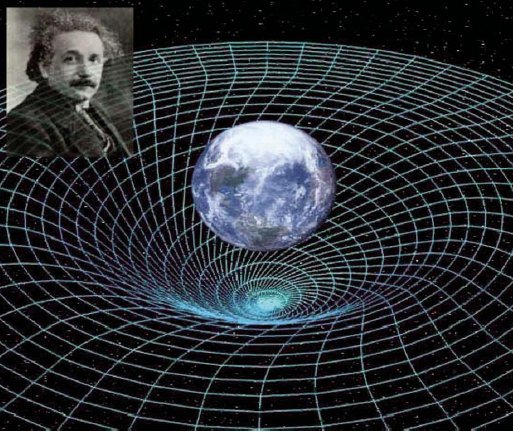
When I was in high school gravity was simple, when I got to university it got complicated, but I still don’t know how gravity sucks.
In high school we were taught Newton’s gravity. Newton explained gravity as a force of attraction between two bodies that had mass. This force was proportional to the product of the masses (their values multiplied together) and divided by the distance between them squared. I was happy with that explanation, and it was perfectly adequate to get us to the moon and back. I did have a reservation that the masses used for gravity were the same as the masses used in Newton’s laws of motion. Much later I found out that this question is called the Principle of Equivalence and has perplexed much smarter people than me.

Just to make this post more scientific let my present Newton’s equation of gravity:

where G is the universal gravitational constant, m1 and m2 are the masses and r the distance between them
That doesn’t look too hard to understand or use but it does pose several philosophical questions, particularly the one I started with, what sucks?
Despite some reservations Newton’s law of gravity works for most things, like predicting the orbits of planets to predicting the trajectories of rockets and inter-planetary satellites. That being the case why do we need an alternative, improved version?
It turns out that Newton’s gravity may provide computational accuracy for most gravity questions, it fails to answer some deep philosophical questions. These questions include answering how gravity provides action at a distance. How do the two masses know about each other’s size and how far apart they are? How fast is the force? Is it instant or limited in speed?
When Einstein published his theory of Special Relativity the speed of gravity was settled at the speed of universal causality, the same as the speed of light. The question remained on what was swapped between the masses that transmitted the gravitational force, and the Equivalence Principle remained an open question.
Then Einstein presented his theory of General Relativity to the world, and everything changed. Not only did this theory predict and explain the precession of the orbit of Mercury around the sun, a topic that was not in the forefront of thought of the general public at that time and isn’t today, and a behavior that was not explained by Newton’s gravity. It also explained gravity’s action at a distance and the Equivalence Principle.

General Relativity claims that mass curves spacetime and spacetime guides mass. In simple terms, it is mass that tells spacetime how to curve, and it is spacetime that tells mass how to move. These claims are wrapped up in Einstein’s equation of General Relativity shown below:

Where:

This is a tensor equation and is obviously much more complicated that Newton’s equation, which perhaps explains why we use Newton’s equation if we can.
However, here’s where I get to my pet peeve. Einstein’s Equation for gravity says that mass (or energy) bends spacetime and that bent spacetime directs the mass/energy how to move, but what are they saying to each other? How are mass and spacetime communicating with each other? What is it that mass communicates to spacetime to persuade it to bend, and what power does spacetime have to make mass follow it’s suggested direction? In a nutshell, how does gravity suck?
Smarter people than me state that mass/energy IS spacetime, but that is beyond my ability to understand. I need a simpler explanation than that. I suppose I’ll just keep wondering how mass/energy sucks on spacetime to make it bend and how spacetime sucks on mass/energy to direct its motion. I guess I’m either dense or stubborn, or perhaps both.


