A while back I saw a gadget called a TrimmBlock that was used to tune the sails of an RC sailboat. Sadly, when I tried to buy one of these, they were no longer available for purchase. To me there was only one option, make one for myself using my 3D printer.
RC sailboats have lots of adjusters on them to tune the sails for maximum performance in the prevailing wind conditions. There are adjusters that set the camber at the foot of the sails, others that set the sheeted in boom angles, yet others that adjust the twist of the sails. Each of these adjustments has its own value, usually a few millimeters to a few tens of millimeters. The TrimmBlock allowed a skipper to measure and set these values easily and quickly.
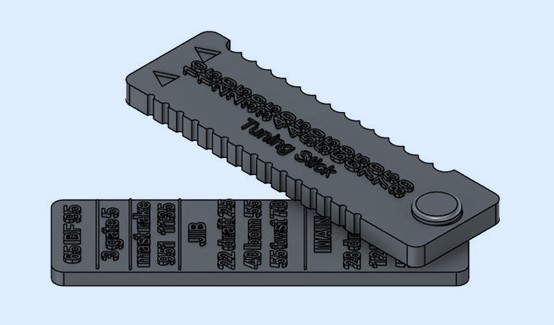
When I set out to reproduce the TrimmBlock I quickly adopted a number of improvements and changes to the design. I also included a pivoting plate attached to the measuring part that had the base measurements for multiple sailboats etched into it.
The measurement plate has large notches along one edge and small notches along the other edge. The notches correspond to the millimeter measurement numbers on top. The triangles at one end indicate where the measurements relate to.
The large notches fit the jib booms whereas the small notches fit the backstay and topping lift lines. To set the camber of a sail, large notch corresponding to the required setting is placed on the boom at the 40% chord position and the reference end placed to touch the foot of the sail. The sail camber adjuster is then used to make the sail fit neatly to the reference end of the tuning stick.
The second plate is pivoted with the measuring plate and holds the settings for the cambers, boom angle, and twist of each sail. In the graphic the measurements are listed for both DF65 and DF95 sailboats. The pivoting rivet comes in two parts that are glued together to complete the assembly.


